Salt in Australian food: are voluntary targets enough?
In plain English
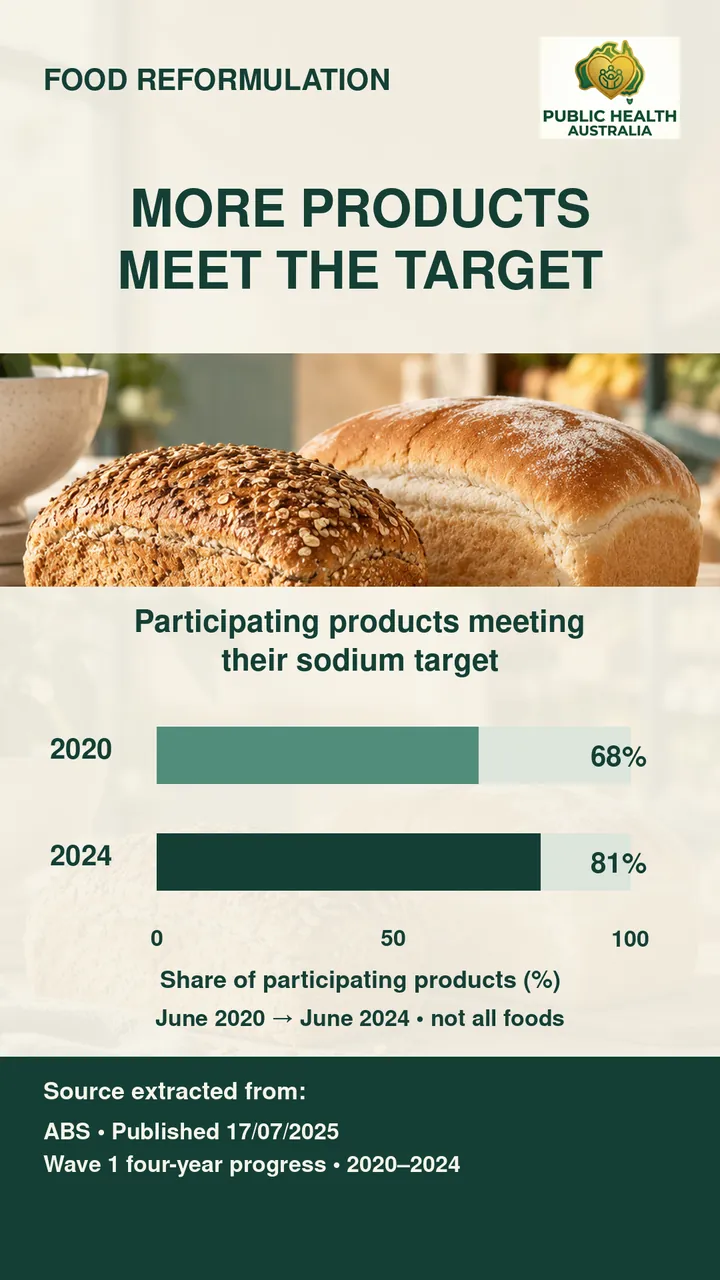
Australia asks food companies to voluntarily reduce sodium, sugar and saturated fat in selected foods. Changing the recipe is called reformulation. There has been progress: by June 2024, 81% of participating products met their sodium target, up from 68% at baseline.
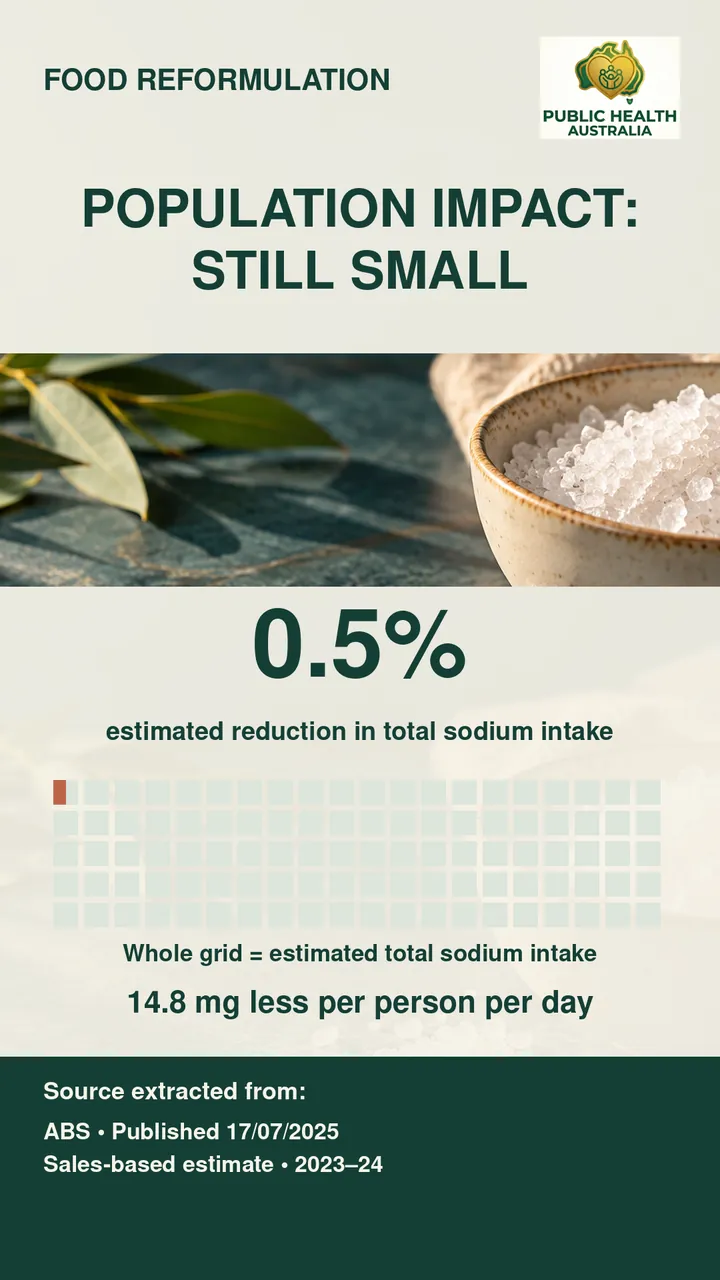
But the Australian Bureau of Statistics (ABS) estimated that the recipe changes reduced sodium intake by just 14.8 mg per person per day, about half of 1% of total intake. Reach is one reason. Participating products made up only 12% of estimated dietary sodium, and many already met the targets before reformulation began. These are sales-based estimates, not measured changes in everyone's diet or proof of fewer heart attacks. An independent supermarket study also found limited progress, especially for saturated fat. Our view: broader coverage, stronger targets and independent reporting, with mandatory limits considered if progress stays inadequate. For now, compare sodium per 100 g between similar foods, alongside price.
Key numbers
- 81% of participating products met their sodium target by June 2024, up from 68% at baseline.
- 14.8 mg estimated reduction in sodium intake per person per day (about 0.5% of total intake).
- 12% share of estimated dietary sodium that came from participating products.
Sources
These are the sources named in the video and its description.
- ABS: Healthy Food Partnership Reformulation Program, Wave 1 four-year progress (17 July 2025)
- Coyle et al.: Independent mid-point assessment (24 July 2025)
- Australian Government: Healthy Food Partnership Reformulation Program review and recommendations (page dated 22 October 2026; recommendations are not implemented policy)
Last checked: 30 October 2026. This is general information, not medical advice.
Spot an error? Message us with the page link and, if you can, a link to the source. We check every report and correct mistakes openly.